
Introduction: The New Era of Financial Analysis
In today’s volatile markets, the ability to spot financial red flags is no longer optional—it’s a critical career skill. Whether you’re a student preparing for a finance career, an entrepreneur protecting your company from hidden risks, or a wealth management professional advising high-net-worth clients, forensic financial analysis using AI is becoming a must-have expertise.
With the rise of AI in financial analysis, companies can no longer hide behind creative accounting. And yet, those who can read between the lines of financial statements will always have an edge—especially when armed with AI-powered forensic accounting tools.
My First Encounter with Hidden Financial Red Flags
I still remember my first real encounter with hidden financial risk. As a young banker, not long after Margaret Thatcher agreed to return Hong Kong to China, I sat in the credit committee of a large global bank reviewing the renewal of a major credit facility for a prominent Asian bank.
Midway through the meeting, someone asked the question that stopped us all: Why were the bank’s investments in subsidiaries larger than its total equity? The financial statements offered no footnotes, no explanations—just silence in the numbers.
When I visited the bank’s headquarters, no one would provide an answer. Later, I discovered the truth: the subsidiary was a Hong Kong mortgage lender. Real estate prices were collapsing, and the uncertainty of property rights under impending Chinese rule meant valuations were plummeting. The bank was sitting on enormous, undisclosed exposure—an early lesson for me in how companies sometimes bury bad news in plain sight.
What Is Forensic Financial Statement Analysis?
Forensic financial analysis goes beyond basic number-crunching. It involves:
-
Detecting accounting fraud before it damages investors and stakeholders.
-
Identifying financial statement manipulation, such as revenue recognition red flags or cash flow distortions.
-
Examining balance sheet anomalies that signal risk or mismanagement.
With AI-powered forensic accounting, analysts can quickly sift through massive amounts of financial data, detect patterns, and flag financial red flags in investing that might otherwise be overlooked.
Why AI Changes the Game
Traditionally, forensic accounting was a manual, time-consuming process. Analysts spent hours reviewing SEC filings, comparing ratios, and cross-referencing market data. AI changes this by:
-
Automating detection of accounting red flags using pattern recognition.
-
Providing predictive insights on cash flow problems warning signs.
-
Highlighting risk indicators in company finances before they escalate.
For example, AI can detect channel stuffing or cookie jar accounting months before traditional audits would catch them.
Who Benefits Most from AI-Enhanced Forensic Accounting?
1. Students
Finance, accounting, and business students who learn AI techniques for financial risk detection will enter the job market with a competitive edge in financial analysis.
2. Entrepreneurs
Understanding investor warning signs in company reports helps business owners maintain financial integrity and credibility with lenders and investors.
3. Financial Analysts
Analysts can detect earnings manipulation tactics faster, improving the accuracy of their investment recommendations.
4. Wealth Management Professionals
Wealth advisors can protect client portfolios by identifying corporate fraud investigation triggers before they impact stock value.
5 Common Red Flags AI Can Detect Faster Than Humans
Overall, AI is faster than humans.
-
Revenue recognition red flags (overstated sales before quarter end)
-
Cash flow problems warning signs (declining operating cash despite rising earnings)
-
Unusual inventory growth (possible overproduction or unsold goods)
-
Debt classification changes (shifting long-term debt to short-term to hide risk)
-
Aggressive expense capitalization (masking declining profitability)
Why You Need This Skill Now
With AI in financial analysis, the barrier to high-quality forensic investigations is lower than ever. Those who master it will be in demand across corporate finance, investment banking, private equity, and auditing.
Ignoring these skills means leaving yourself—and your investments—vulnerable to hidden financial risks.
Lessons from the Headlines
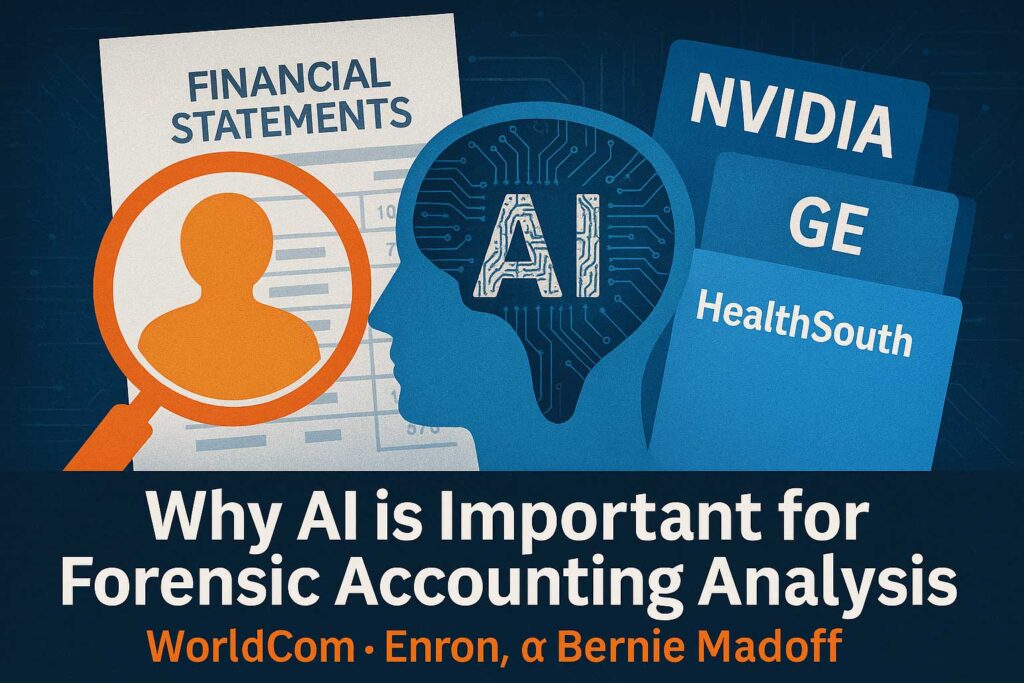
From NVIDIA, GE, and HealthSouth—companies recently cited by the SEC—to historical corporate scandals like Enron, WorldCom, and Bernie Madoff’s Ponzi scheme, the story is the same: financial deception thrives in opacity. The faster you can detect it, the more you can protect yourself and your clients.
Take the Next Step
Our new Udemy course, Forensic Financial Analysis Using AI, co-taught by Gary Rushin, CPA, MS-Computer Science, and Chris Haroun, equips you with practical, real-world techniques to detect fraud, spot financial statement red flags, and leverage AI tools for auditors and investors.
[→ Enroll Now and Gain the Skills to Protect Your Investments]
Course Summary – Forensic Financial Statement Analysis Using AI
Co-taught by Gary Rushin, CPA, MS-Computer Science and Chris Haroun, MBA, Award-Winning Business Professor, this hands-on course equips you with the tools, techniques, and real-world insights to detect financial deception and uncover hidden risks—faster and more accurately—using the power of Artificial Intelligence.
You’ll learn how to:
-
Spot red flags in financial statements before they become costly problems.
-
Detect accounting manipulation such as aggressive revenue recognition, cookie jar reserves, and cash flow distortions.
-
Apply AI-powered forensic accounting tools to quickly analyze corporate filings, identify anomalies, and highlight fraud risk indicators.
-
Review real-world case studies from companies like NVIDIA, GE, HealthSouth, Enron, and WorldCom, plus lessons from high-profile frauds such as Bernie Madoff.
-
Integrate forensic financial analysis into investment, lending, and business decisions for maximum protection and profitability.
Whether you’re a student preparing for a finance career, an entrepreneur protecting your company, a financial analyst refining your risk detection skills, or a wealth management professional safeguarding client portfolios, this course delivers the practical knowledge you need to stay ahead in a market where financial truth can be hard to find.
By the end of the course, you’ll have a proven framework for forensic analysis—enhanced with AI—to confidently detect risks, uncover opportunities, and make better-informed financial decisions.