

Why Recognizing Financial Distress Early Matters
Financial distress doesn’t arrive with flashing warning lights—it creeps in quietly, often disguised as “temporary” setbacks. For business owners, the ability to recognize early distress signals is one of the most valuable skills you can develop. Detecting issues early can be the difference between a strategic recovery and a costly failure.
In this article, you’ll learn the five most telling financial distress indicators, how to spot them in your financial statements, and what steps you can take to protect your company’s future.
What You’ll Learn
-
- How to recognize declining sales, rising expenses, shrinking profits, growing debt, and cash flow shortfalls.
-
- How to use financial statements to identify trends before they become crises.
-
- How to develop a proactive financial monitoring process that keeps your business resilient.
By mastering these insights, you’ll gain the confidence to act early—and prevent small problems from becoming existential threats.
How to Apply This Knowledge
Regularly monitor your business’s financial statements—not just once a year at tax time. When you spot a red flag, move quickly. A measured, early response can preserve cash, protect relationships, and buy time to restructure operations before damage becomes irreversible.
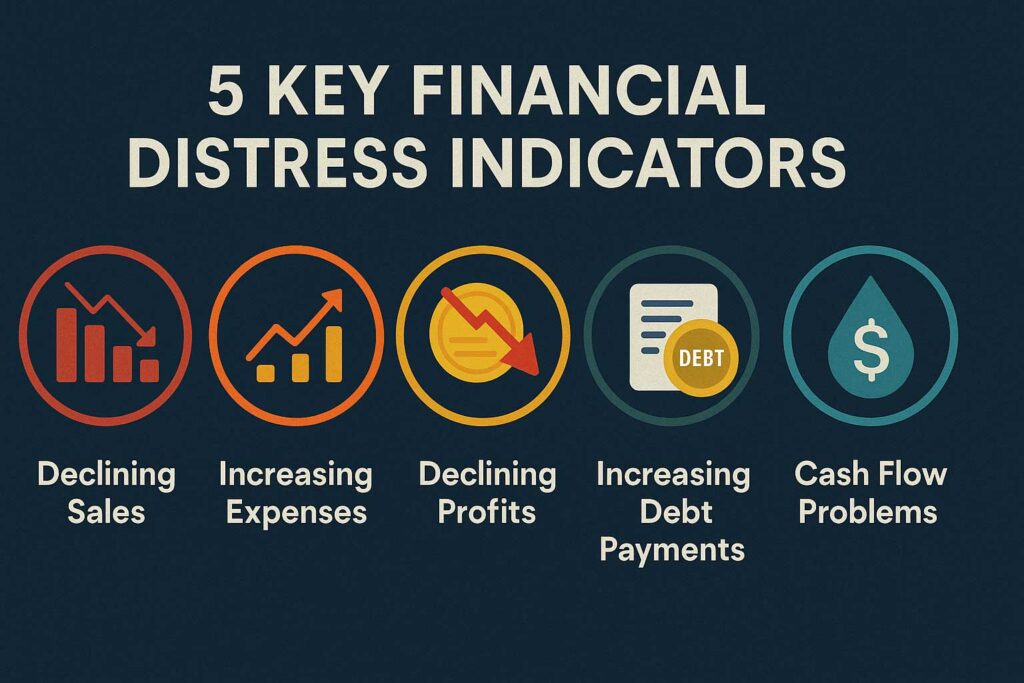
The Five Key Indicators of Financial Distress
1. Declining Sales
A sustained drop in sales is more than just a slow month—it’s a signal to investigate deeper issues such as shifting customer preferences, competitive pressure, or ineffective marketing.
How to Track and Interpret Sales Trends
-
- Use consistent reporting: Track weekly, monthly, and quarterly sales data to identify patterns.
-
- Monitor KPIs: Revenue growth rate, average transaction value, customer acquisition cost, and retention rates.
-
- Leverage CRM and analytics tools: Visualize trends and segment data by product, region, or customer type.
-
- Benchmark: Compare against historical data, industry averages, and competitors to see if the issue is market-wide or company-specific.
Pro tip: A decline lasting more than three consecutive quarters—especially if paired with high inventory or customer churn—often signals a systemic issue requiring immediate intervention.
2. Rising Expenses Outpacing Revenue
If your costs grow faster than sales, margins shrink, and cash erodes. Rising expenses may point to inefficiencies, lack of cost control, or operational bloat.
How to Monitor and Respond
-
- Categorize costs into fixed vs. variable to pinpoint problem areas.
-
- Track the expense-to-revenue ratio—a rising trend is a warning sign.
-
- Use accounting or ERP systems to compare spending against historical data and budgets.
-
- Review contracts, renegotiate supplier terms, and eliminate wasteful expenditures.
Pro tip: Small, steady expense increases often go unnoticed—until they collectively erode profitability. Schedule quarterly cost reviews.
3. Shrinking Profits
Declining net or operating profits are often the result of both falling revenue and rising costs. External pressures—like increased competition—or internal inefficiencies can both play a role.
Action Steps
-
- Review gross and operating margins for signs of compression.
-
- Identify whether the issue is pricing power, cost inflation, or sales volume.
-
- Consider strategic changes—new pricing models, product mix adjustments, or process improvements.
4. Growing Debt Burden
Debt can be a growth tool—but when repayments grow faster than profits, it’s a warning sign. A debt-to-equity ratio above 1.0 indicates rising leverage risk.
What to Watch
-
- Track debt-to-equity and interest coverage ratios.
-
- If cash flow struggles to cover interest and principal payments, explore refinancing, restructuring, or asset sales.
5. Cash Flow Shortfalls
Negative operating cash flow means your business isn’t generating enough cash to sustain itself—even if it’s profitable on paper.
Diagnose the Cause
-
- Review your cash flow statement to pinpoint whether the issue stems from slow collections, high expenses, or inventory build-up.
-
- Implement tighter credit policies, faster invoicing, and more disciplined cash management.
Real-World SEC Warning
In 2024, the SEC sanctioned a public company for misclassifying operating cash flows as investing activities—misleading investors about its financial health. This highlights two lessons:
-
- Cash flow reporting must be accurate.
-
- Investors and business owners alike need to read statements critically—not just rely on the headline numbers.
Mastering Your Financial Statements
What is critical is mastering your financial statements, which shows the business scorecard.
-
- Balance Sheet: Monitor liquidity (current ratio) and leverage (debt ratios).
-
- Income Statement: Watch profit margins for erosion.
-
- Cash Flow Statement: Track if operations are consistently generating positive cash.
When Trouble Appears
If you spot signs of financial distress:
-
- Engage creditors early to renegotiate terms.
-
- Seek expert financial advice before problems escalate.
-
- Implement a turnaround plan with measurable milestones.
Final Word
Knowing the indicators of financial distress isn’t just a defensive skill—it’s a strategic advantage. By spotting trends early and acting decisively, you can protect your business, preserve stakeholder confidence, and position yourself for recovery or growth.
Remember: Financial problems rarely happen overnight. They start as whispers in your numbers. The sooner you listen, the sooner you can respond.
If you’d like, I can also create a companion one-page “Financial Distress Early Warning Checklist” you could attach to this article as a downloadable PDF lead magnet. That would make this piece both educational and a business development tool.