
Introduction to Startup Funding
Early-stage companies often rely on external funding from venture capital firms and angel investors to fuel their growth. Startup fundraising is a critical process for ambitious founders seeking to raise money and scale their businesses.
Both SAFE and convertible notes are popular options for startup financing, but they have distinct differences. Instruments like SAFE and convertible notes were popularized in Silicon Valley to streamline the fundraising process for early-stage startups.
Understanding the pros and cons of each instrument is crucial for early-stage startups to make informed decisions.
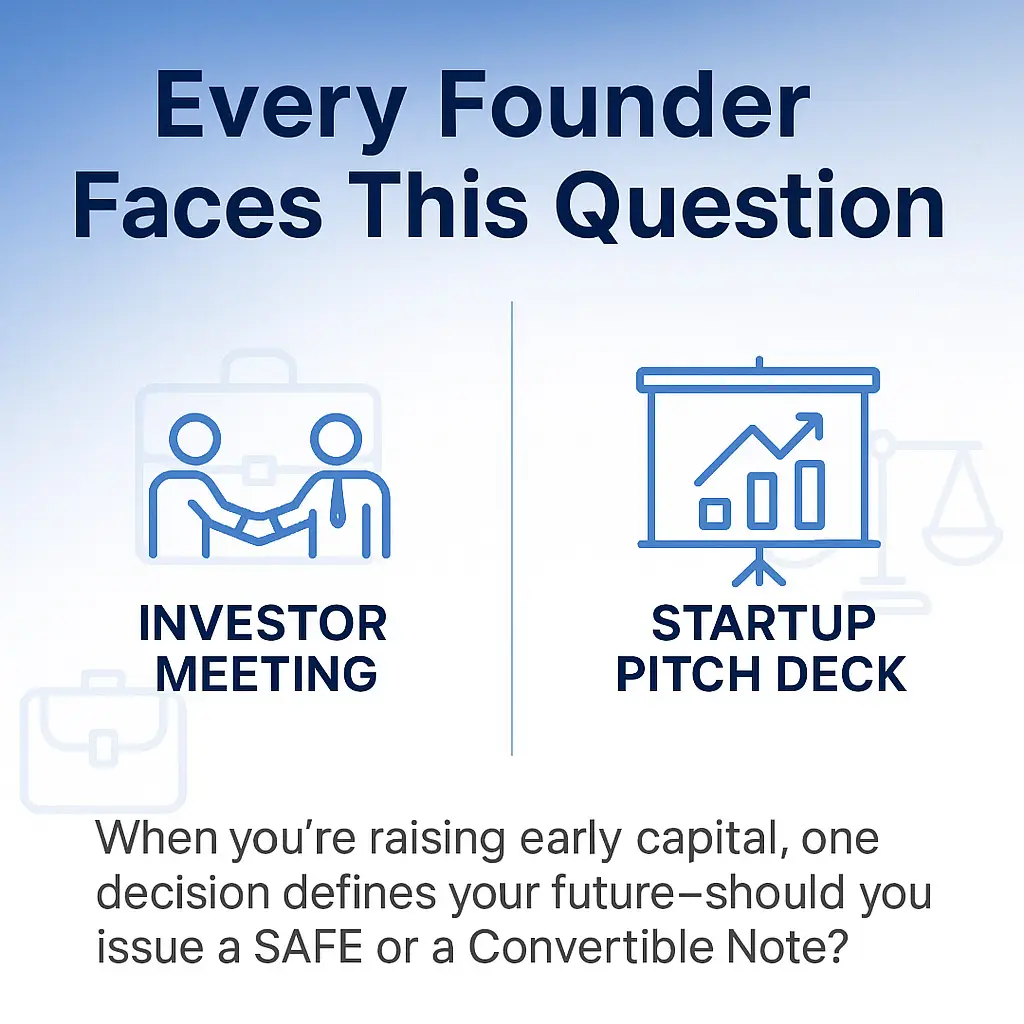
The choice between a SAFE and a convertible note depends on the startup’s specific needs, risk tolerance, and the preferences of its investors.
Startup financing options, including SAFE (Simple Agreement for Future Equity) and convertible notes, can significantly impact a company’s valuation and future equity structure.
Understanding Convertible Notes
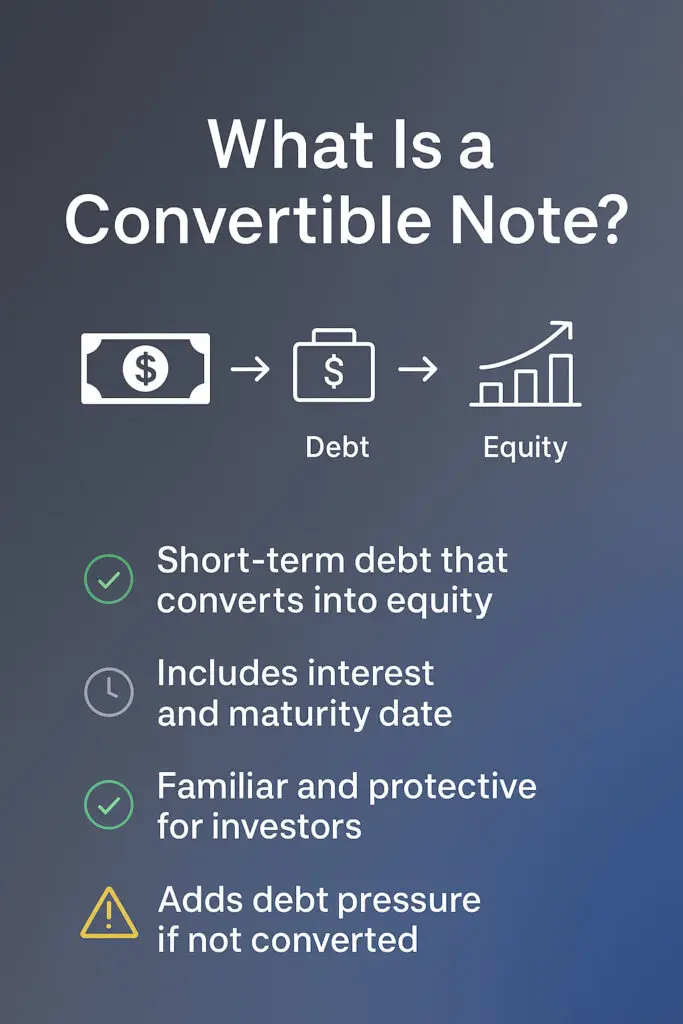
Convertible notes are used in early-stage startup raises to provide funding, allowing startups to borrow money that can later convert into equity once certain conditions are met. Unlike SAFEs, convertible notes include an interest rate, and this interest rate accrues until the note is converted or repaid.
A convertible note is a debt instrument that accrues interest and has a maturity date, unlike SAFEs. Company valuation is typically deferred until a fundraising round or the next round, which acts as a conversion trigger for the note. Convertible notes provide investors with the opportunity to lend money to a startup, offering the option to convert the debt into equity at a later date. Conversion triggers, such as the next round of funding, determine when the note converts into equity, and the amount of equity depends on the terms set in the note, including discount rates and valuation caps. The conversion trigger is usually a subsequent funding round, at which point the note converts into preferred stock. Convertible notes often include a valuation cap to protect investors from overvaluation. Early-stage founders should consider the interest payments and maturity date when choosing a convertible note.
Understanding SAFEs
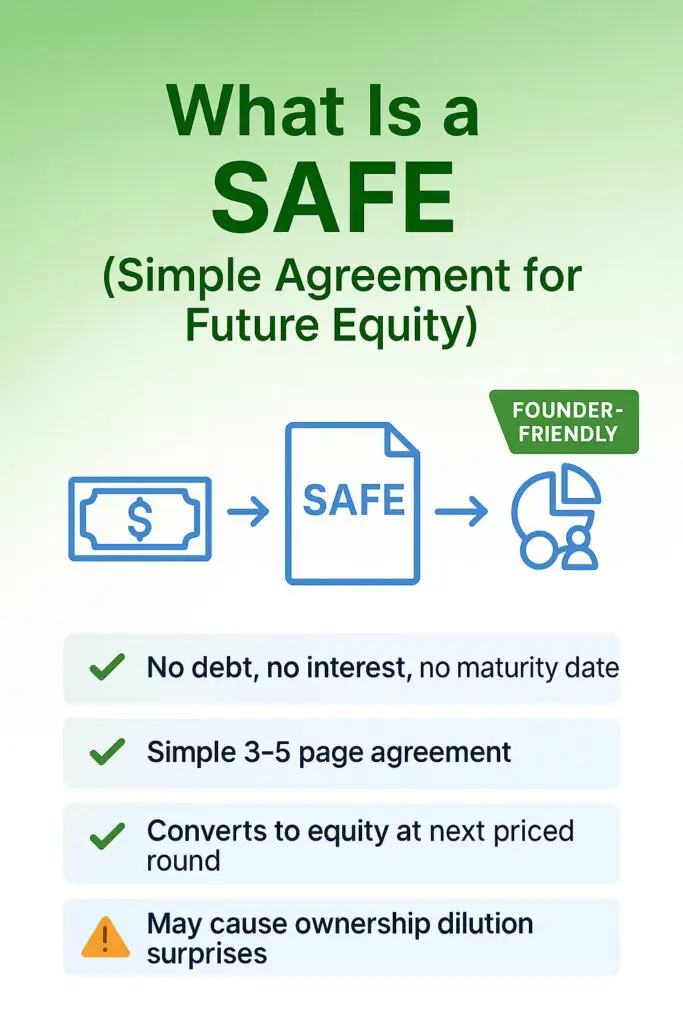
A SAFE (Simple Agreement for Future Equity) is an instrument that allows investors to purchase equity at a later date, typically at a discounted rate. The initial investment made through a SAFE provides the startup with early capital.
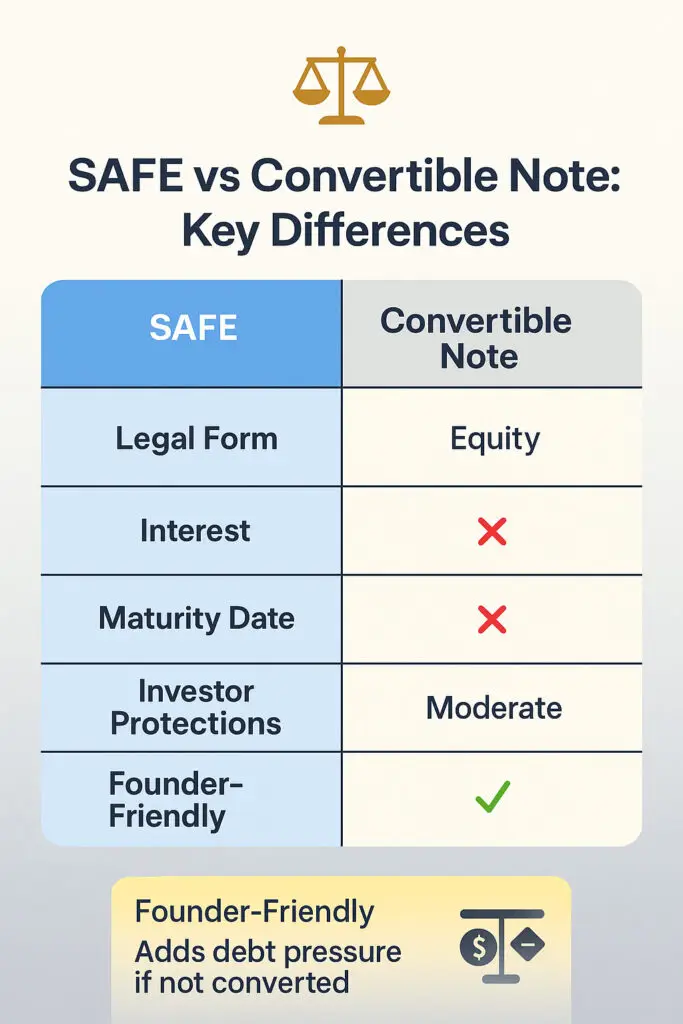
SAFEs do not accrue interest and do not have a maturity date, reducing the pressure on early-stage startups to repay the investment.
SAFEs are often used by very early-stage startups to raise capital quickly and defer valuation discussions.
SAFE investors receive equity at a later date, usually during a subsequent funding round, at a valuation determined by the company’s valuation at that time. Valuation caps are often included in SAFEs to limit the price at which the investment converts, providing investors with potential upside if the company experiences rapid growth.
SAFEs are considered a simpler and more straightforward alternative to convertible notes.
Key Differences Between SAFEs and Convertible Notes
The key differences between SAFEs and convertible notes lie in their structure, with SAFEs being equity instruments and convertible notes being debt instruments. Both SAFEs and convertible notes are alternatives to traditional equity financing, which involves raising capital through the sale of company shares during larger funding rounds.
Convertible notes offer investors more protection, including interest payments and a maturity date, whereas SAFEs do not.
SAFEs are often preferred by early-stage founders due to their simplicity and lack of debt obligations. By deferring the company’s valuation until a later equity round, both SAFEs and convertible notes can allow startups to achieve a higher valuation before selling equity, which can benefit founders.
The choice between a SAFE and a convertible note depends on the startup’s risk tolerance, investor preference, and specific financing needs.
Understanding these differences is crucial for early-stage companies to navigate the startup financing landscape. Legal fees can vary depending on the complexity of the chosen instrument and should be taken into account when making a decision.
How to Choose Between a SAFE and a Convertible Note
Early-stage founders should consider their startup’s specific needs. This includes the amount of capital required, the expected growth rate, and the investor preference. Exceptional founders and high-growth companies may attract more investor interest and have more options when choosing between SAFE and convertible notes.
The decision to choose a SAFE or a convertible note should be based on the startup’s risk tolerance, financial situation, and future equity structure. Demonstrating early traction, such as signups, waitlists, or pilot customers, can make it easier to secure favorable terms from investors.
It is essential to weigh the pros and cons of each instrument, including interest payments, maturity dates, and valuation caps.
Consulting with financial advisors and lawyers can help early-stage founders make an informed decision.
The choice between a SAFE and a convertible note can significantly impact the startup’s valuation, funding rounds, and future equity structure.
Valuation and Funding
Company valuation and a startup’s valuation are critical factors in determining the conversion price of a convertible note or SAFE.
Early-stage companies should consider the valuation cap and discount rate when negotiating a convertible note or SAFE.
The valuation cap sets an upper limit on the company’s valuation, protecting investors from overvaluation.
The discount rate determines the price at which the investor purchases equity, usually at a discounted rate.
Understanding valuation and funding is crucial for early-stage startups to navigate the startup financing landscape.
Seed funding rounds often utilize SAFEs or convertible notes to establish terms before a formal valuation is conducted.
Tax Implications and Investor Perspectives
The tax implications of SAFEs and convertible notes differ, with convertible notes being considered debt instruments, while SAFEs are considered equity instruments.
Investors should consider the tax implications of each instrument, including the potential for capital gains tax treatment.
Early-stage founders should understand the investor perspective, including their risk tolerance, expected return on investment, and investment horizon.
The choice between a SAFE and a convertible note should be based on the investor’s preferences and the startup’s specific needs.
Tax implications and investor perspectives can significantly impact the startup’s funding rounds and future equity structure.
Conversion and Exit Strategies
The conversion trigger for a convertible note or SAFE is usually a subsequent funding round, at which point the instrument converts into preferred stock.
Early-stage founders should consider the conversion price, including the valuation cap and discount rate.
If a startup fails, both SAFE and convertible note holders are typically among the last to be paid in a liquidation scenario, and often investors may not recover their investment if the company’s assets are insufficient to cover their claims. Understanding the implications for investors and debt instruments when a startup fails is essential when evaluating these financing options.
The exit strategy for investors, including the potential for an initial public offering (IPO) or acquisition, should be considered when choosing a SAFE or convertible note.
Understanding conversion and exit strategies is crucial for early-stage startups to navigate the startup financing landscape.
The choice between a SAFE and a convertible note can significantly impact the startup’s exit strategy and future equity structure.
Final Considerations and Next Steps
When considering SAFE notes and convertible notes for early-stage companies, it’s essential to weigh the key differences and how they impact startup financing. Both safes and convertible notes offer a way to defer valuation discussions, but they have distinct implications for early-stage startups. Convertible notes, in particular, can provide a valuation cap, protecting early investors in the event that the company’s valuation increases significantly. Unlike convertible notes, SAFE notes do not accrue interest and lack a maturity date, making them a more flexible option for very early-stage startups.
As a founder, it’s crucial to understand how much equity you’re giving up with each option and how it affects your cap table. Venture capital firms often prefer convertible notes due to the added security of interest payments, but angel investors may be more open to SAFE notes. The pre-seed stage is a critical time for startup financing, and choosing the right instrument can make a significant difference in the fundraising process.
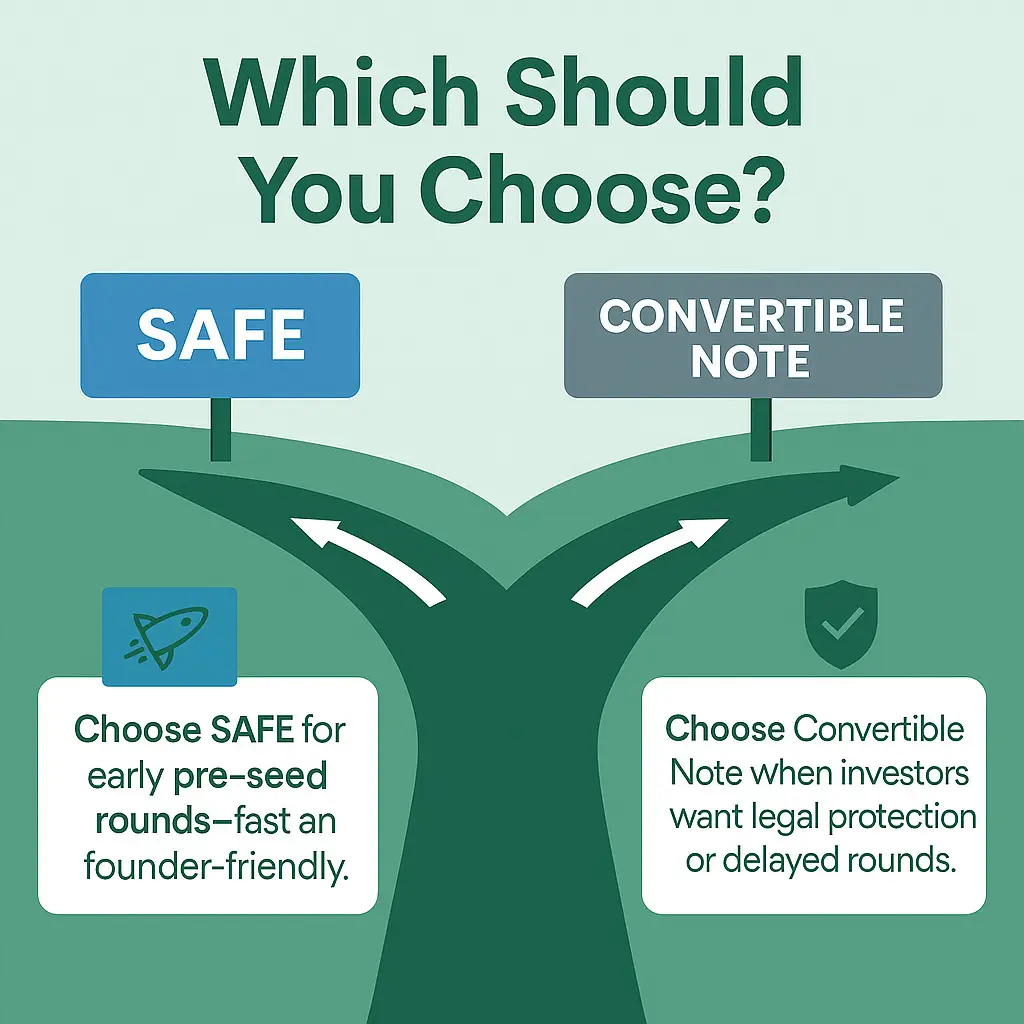
When deciding between a SAFE note and a convertible note, consider your risk tolerance, the current state of your startup, and your investor preference. If you’re looking for a more straightforward and faster process, SAFE notes might be the better choice. However, if you’re seeking more protection for your investors and a clearer repayment timeline, convertible notes could be more suitable.
Final Considerations and Conclusion
In the early stage, it’s vital to focus on growth and proving your startup’s potential. The choice between SAFE notes and convertible notes should align with your company’s valuation, funding goals, and investor expectations. As you navigate the startup financing landscape, keep in mind that both SAFE notes and convertible notes can be effective tools for raising capital, but it’s essential to understand their implications and choose the one that best fits your situation.
Ultimately, the decision between SAFE notes and convertible notes depends on your specific circumstances and priorities. It’s recommended that you consult with financial advisors and legal experts to determine the most suitable option for your startup. By doing so, you’ll be better equipped to make an informed decision and secure the funding you need to drive your business forward.
In conclusion, SAFE notes and convertible notes are both viable options for early-stage startups looking to raise capital. By carefully considering the key differences, benefits, and drawbacks of each instrument, you can make an informed decision that aligns with your startup’s goals and priorities. Remember to stay focused on your company’s growth and potential, and don’t hesitate to seek guidance from experts in the field. With the right financing strategy in place, you’ll be well on your way to achieving success in the competitive world of tech startups.
ABOUT GARY RUSHIN
Gary Rushin is a seasoned CPA, former investment banker, and turnaround professional with over 30 years of experience in accounting, finance, and business strategy. He has advised Fortune 500 companies, growth-stage startups, and distressed businesses on financial restructuring, corporate governance, and risk management. Known for his expertise in forensic accounting and financial statement analysis, Gary combines deep technical knowledge with AI-driven tools to help entrepreneurs, investors, and executives uncover hidden risks, protect capital, and drive sustainable growth. Reach out to Gary at https://garyrushinunplugged.com/