

Key Takeaways
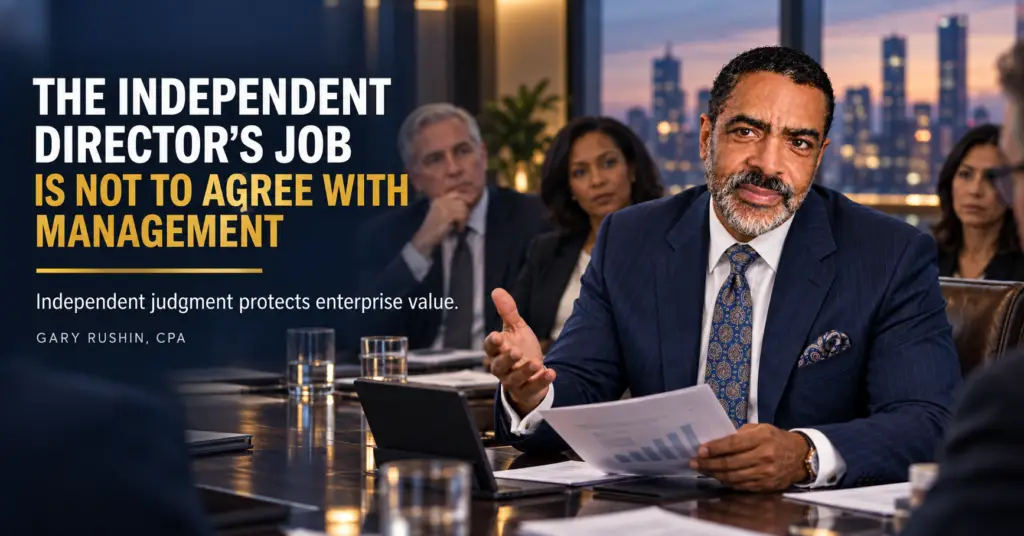
The primary duty of an independent director is to exercise objective judgment on behalf of the company and its shareholders-not to rubber-stamp management’s proposals. Modern corporate governance standards, from the New York Stock Exchange to the UK Corporate Governance Code, expect independent directors to challenge management where the evidence demands it.
-
Constructive dissent, rigorous questioning, and independent thinking are what make an effective board and protect long-term shareholder value.
-
Behavioral independence-the willingness to actually disagree-matters far more than simply meeting structural independence criteria on paper.
-
Boards that fail to question management risk catastrophic outcomes, as demonstrated by collapses at Enron, Wirecard, and other high-profile failures.
-
Gary Rushin, CPA, exemplifies the kind of independent board director candidate boards need: 40+ years of experience across audit, risk management, and corporate finance, with the courage and expertise to question management thoughtfully.
-
This article provides practical guidance for both aspiring directors seeking board opportunities and boards seeking to strengthen director independence and board composition.
Introduction: Why Agreement Is Not the Independent Director’s Job
When Wirecard collapsed in 2020, wiping out billions in shareholder value, investigators found a supervisory board that had repeatedly failed to act on external warnings about fraudulent third-party transactions. The board was diverse in background and geography. What it lacked was the willingness to challenge management aggressively and demand transparency. The result was one of Europe’s largest corporate fraud scandals.
This is not an isolated case. It is the recurring pattern of governance failure.
The independent director’s legal and ethical obligations run to the company and its shareholders-not to the CEO or the executive management team. A board member is not hired to be a “team player” for management. The independent director role is that of a disciplined, objective decision-maker whose value lies precisely in the ability to say “no” when “no” is warranted.

Independent directors, independent board members, and independent board directors are the backbone of effective corporate governance. Without their willingness to provide proper oversight, boards become ceremonial, and shareholders bear the consequences.
The rest of this article explores how independence is defined, how it operates in practice, and how experienced candidates like Gary Rushin, CPA, can strengthen an effective board.
Defining Independent Directors and Director Independence
An independent director is a corporate director with no material financial, employment, or close personal ties to the company, its senior executives, or its controlling shareholders. Independent directors must have no material relationships with the company-a principle that underpins every major governance framework.
In the U.S., key listing rules on the New York Stock Exchange and Nasdaq require a majority of independent directors on public company boards. Post–Sarbanes-Oxley (2002), these rules tightened significantly, establishing bright-line tests: no employment within three years, no payments exceeding $120,000 aside from board fees, and no other relationships that impair impartial judgment. The UK Corporate Governance Code sets similar criteria for independent directors, and the Companies Act 2006 (section 173) explicitly requires directors to exercise independent judgment.
Director independence operates across three dimensions:
-
Structural independence: No formal ties-employment, consulting contracts, or significant ties-with management or the company.
-
Financial independence: No performance-based incentives or shareholdings that compromise objectivity. Independent directors commonly receive fixed director fees, and compensation structures often include both cash and equity components. Stakeholders should view director fees as fair, and independent directors avoid performance-based pay to prevent bias.
-
Behavioral independence: The willingness to disagree, ask hard questions, and delay decisions when information is insufficient.
Why does this matter?
-
It avoids conflicts of interest in decision-making.
-
It reinforces investor confidence in the board’s objectivity.
-
It enables objective risk oversight and strengthens strong governance.
-
Independent directors enhance objectivity in board oversight.
Independence is not a status box to tick. It is a continuous, active stance each board member takes throughout their tenure.
The Misconception: “Good” Directors Support Management
A persistent myth holds that good directors support the CEO’s agenda, minimize friction, and preserve boardroom harmony. This belief is not just flawed-it is dangerous.
The fiduciary duties of care and loyalty require independent directors to act in the best interests of the corporation and its shareholders, not to display personal loyalty to senior executives. The same fiduciary duties apply whether a director serves on a publicly listed company board or a private company board. “Loyalty” in governance means loyalty to the enterprise and its owners, not to the people running it.
Consider the evidence. At Enron in 2001, the board-though well-credentialed-failed to intervene despite red flags around off-balance-sheet entities and aggressive mark-to-market accounting. CEO dominance went unchecked. The result was one of the largest corporate frauds in American history.
At Wirecard (circa 2015–2020), the supervisory board lacked the technical knowledge to understand complex cross-border financial flows and repeatedly ignored external warnings. Internal board dynamics compromised independent directors’ judgment, and cognitive biases-especially authority bias and social cohesion-distorted their decision-making.
Constructive disagreement by independent directors helps ensure decisions benefit all shareholders. Boards that challenge management’s proposals prevent groupthink and ensure thorough evaluation of strategies.
Research confirms dissent is rare-only about 4–5% of proposals in mandatory disclosure settings are opposed by at least one independent director. But when dissent does occur, it correlates with better outcomes: reduced earnings manipulation, greater transparency, and improved governance.
Core Responsibilities of Independent Directors in Modern Corporate Governance
Independent directors carry oversight responsibilities that inherently require independent judgment, not passive agreement. Here are the core areas:
-
Strategic oversight: Examining growth proposals, acquisition plans, and corporate strategy. Independent directors provide unbiased strategic guidance to management and unbiased strategic counsel, testing whether forecasts are realistic or overly optimistic.
-
Risk and audit oversight: Challenging aggressive accounting estimates, probing internal controls weaknesses, and investigating whistleblower reports. Independent directors ensure compliance with legal and ethical standards.
-
CEO selection and evaluation: Evaluating succession plans, assessing performance metrics, and conducting performance evaluations of executive leadership.
-
Executive compensation: Ensuring executive pay structures do not encourage short-termism. Independent directors help ensure that executive pay aligns with long-term performance metrics and act as a check against conflicts of interest and excessive management compensation.
-
Capital allocation: Questioning whether proposed investments or distributions truly enhance shareholder value.
Independent directors typically serve on audit and nomination committees. They serve on key committees, including audit and compensation committees. Their primary focus is on accountability and governance rather than day-to-day operations. They monitor executive performance and corporate strategy without involvement in daily operations.
They uphold fiduciary duties of care, loyalty, and good faith. They provide objective oversight and challenge management decisions. Independent directors act as liaisons between shareholders and management and play a crucial role in safeguarding minority shareholders’ interests.
In sensitive matters-related-party transactions, whistleblower claims, internal investigations-independent directors provide an independent perspective on major corporate actions and risk management. They bring outside expertise and perspective to board discussions, ensuring no single voice dominates decisions.
How Independent Directors Add Value by Challenging Management
The value independent directors offer is not agreement-it is the quality of their questions.
Independent directors ask probing questions to evaluate management proposals and assumptions. They use structured information flow to evaluate company performance and risks. They improve decision quality by insisting on alternative scenarios and stress-testing key assumptions before the board approves decisions.
Concrete examples of value-adding challenge:
-
An independent non-executive director on a technology company board pushing for cybersecurity investment before a major breach, forcing the management team to allocate resources that prevented a data disaster.
-
Outside directors on a financial services board questioning leverage ratios ahead of a downturn, leading to de-risking that protected the company during the 2008 crisis.
-
An independent board member on a manufacturing company board insisting on environmental liability analysis before a major acquisition, avoiding a regulatory quagmire.
Independent directors help mitigate conflicts of interest in decision-making by depersonalizing challenges and focusing on data. When management proposals survive rigorous challenge from fellow board members, those proposals emerge stronger and carry more legitimacy with investors and regulators.
The key difference between a board that creates value and one that destroys it is whether independent directors are willing to say, “Show me the evidence.”

Board Composition: Building an Independent Board That Can Say “No”
Board composition determines whether a board can realistically resist undue management influence. A company board dominated by inside directors or individuals with significant ties to the CEO will struggle to provide an impartial perspective.
Best practices for an independent board include:
-
Majority-independent boards, as required by major stock exchanges for listed company boards.
-
Fully independent audit, compensation committee, and nomination committees.
-
An independent board chair or lead independent director to set the tone.
-
Limits on overboarding-restricting how many outside boards a director serves on-to ensure adequate time commitment.
-
Term limits for independent directors, which often cap tenure at nine years. Nine years is a common tenure limit for independent directors, as recommended by the UK Corporate Governance Code.
-
Diversity of industry expertise, geography, gender, and background to reduce groupthink.
Appointment processes for independent directors involve extensive reference checks, often supported by search firms. Finding qualified independent directors is increasingly difficult, especially those with specialized knowledge in areas like AI, ESG, or cybersecurity.
Concentrated ownership structures can limit independent directors’ influence, which makes board composition even more critical in companies with controlling shareholders.
Boards should also recognize that independent directors who do not hold management positions and have no personal financial stake beyond fair director fees bring the clearest impartial perspective.
From Compliance to Courage: Behavioral Independence in the Boardroom
A meaningful gap exists between formal independence and behavioral independence. A director may meet every regulatory definition and still never challenge management in board discussions.
Psychological pressures that discourage dissent are well-documented:
-
Social cohesion: Not wanting to disrupt relationships with other board members.
-
Reciprocity: Feeling obligated because the CEO or board leader recommended the director for the board seat.
-
Authority bias: Deferring to the CEO or the executive management team out of habit.
-
Regulatory ambiguities can also undermine independent directors’ roles, creating confusion about the boundaries of their oversight role.
Courageous corporate directors regularly ask for more data, delay votes when information is incomplete, and insist on second opinions for high-risk board decisions. Here are phrases an effective independent board member might use:
-
“Help me understand the downside if this projection doesn’t hold.”
-
“What would our decision be if this project were not championed by you?”
-
“Can we see an independent third-party analysis before we proceed?”
-
“I’m not comfortable voting until we have answers to these questions.”
Behavioral independence is what differentiates truly effective board members from nominally “independent” ones. It is the essence of the independent director role and the foundation of good corporate governance.
Tools and Practices for Constructive Challenge, Not Conflict
Disagreement does not have to mean conflict. The goal of board work is not to win arguments but to reach better, more robust decisions.
Practices that enable constructive challenge:
|
Practice |
Purpose |
|---|---|
|
Pre-read questions |
Allow directors to submit written questions before board meetings, ensuring management prepares data in advance. |
|
Red-team exercises |
Assign a group of directors to argue against a proposed strategy, surfacing risks the majority may overlook. |
|
Scenario analysis workshops |
Model best-case, base-case, and worst-case outcomes for major investments or strategic moves. |
|
Executive sessions |
Allow independent directors to meet without management present, aligning on concerns before formal discussions. |
|
Structured decision frameworks |
Use risk matrices and hurdle rates to depersonalize disagreement and focus on evidence. |
Annual board and director self-evaluations should explicitly ask whether independent directors feel safe challenging management. These evaluations should assess board performance holistically, including whether dissenting views are surfaced and recorded.
The objective is not opposition for its own sake. It is ensuring that every major decision receives proper oversight and stands up to regulatory and investor scrutiny.
The Role of the Lead Independent Director and Board Chair in Enabling Dissent
The board chair or lead independent director sets the tone for whether questioning management is expected or punished. A strong lead director manages board agendas, ensures adequate time for discussion, and invites quieter independent directors to voice concerns.
Post-2008 NYSE policies require non-management executive sessions led by a presiding or lead independent director, reinforcing board independence. These sessions give independent non executive directors a private forum to discuss concerns and prepare for difficult conversations.
Consider a scenario: a lead independent director notices that board discussions around CEO succession are being consistently deferred by the current CEO. A strong lead director would place the item firmly on the agenda, ensure the board has access to independent executive search data, and encourage open debate about the timeline-even if the CEO resists.
Even without a formal lead director title, independent board members can collectively insist on practices that promote openness. Every director serves an oversight role, and the collective expectation of challenge creates an environment where good directors thrive.
Regulatory, Legal, and Investor Expectations Around Independent Oversight
Regulatory expectations have risen dramatically since the early 2000s scandals and the 2008 financial crisis. In the U.S., the SEC, stock exchanges (including the New York Stock Exchange), and Delaware case law all impose substantive duties on independent directors. In the UK and EU, the UK Corporate Governance Code (updated in 2024) and the EU Shareholder Rights Directive set similar standards.
Proxy advisory firms like ISS and Glass Lewis increasingly evaluate director independence and board effectiveness when advising institutional investors on how to vote during director elections. Boards perceived as insufficiently independent face “against” recommendations, damaging reputations and investor confidence.
Courts retrospectively assess director independence in litigation. They examine whether directors appeared too close to management, failed to question obvious risks, or neglected to document dissent. Independent directors who record their questions and dissenting views in board minutes are better protected legally.
Independent directors who merely agree expose themselves to breach of duty claims. Those who ask tough questions and document their reasoning are far better positioned if governance failures arise.
Risks of Over-Alignment with Management for Independent Board Members
When independent directors simply agree with management, the consequences are tangible:
-
Shareholder litigation: Courts hold directors accountable for failures of oversight.
-
Regulatory enforcement actions: Regulators target boards that failed to exercise proper oversight.
-
Reputational damage and personal liability: Directors face public criticism and potential legal exposure.
-
Personal embarrassment: When failures become public, directors who rubber-stamped decisions face career consequences.
The boards of Lehman Brothers (2008) and Carillion (2018) were both criticized as “captured” boards-nominally independent but functionally aligned with management. Long tenure, repeated re-election without challenge, and social ties with executives gradually eroded their director independence.
Independent directors should regularly reassess conflicts of interest, their time commitment, and their ability to remain objective. In some cases, when a director fundamentally disagrees with a major decision and cannot influence the outcome, resignation may be the only ethical choice-and a powerful signal to shareholders and regulators.

What Boards Should Look for When Appointing Independent Directors
An independent directorship demands more than a prestigious resume. Boards should prioritize:
-
Professional expertise: Financial literacy, industry expertise, and familiarity with modern risk areas (ESG, AI, cybersecurity, geopolitical risk).
-
Behavioral courage: A track record of pushing back on majority views or CEO-driven agendas.
-
Integrity and independence of mind: No significant ties that could compromise objectivity.
-
Capacity for time-intensive oversight: Independent board work requires real commitment, not token attendance.
-
Crisis management experience: Directors who have navigated downturns or regulatory crises bring perspective that cannot be taught.
Nomination committees should probe behavioral independence during interviews. Ask candidates to describe a time they disagreed with a CEO or majority view and how they handled it. Boards should use search firms that look beyond the usual networks to find candidates with cross-border experience and multi-decade careers.
Diverse backgrounds-industry, geography, gender, and ethnicity-reduce groupthink and broaden perspectives. The best boards combine directors who can interrogate management competently across finance, technology, operations, and regulatory compliance.
Why Gary Rushin, CPA, Embodies the Independent Director Who Won’t Just Agree
Gary Rushin, CPA, brings more than 40 years of professional experience across audit, risk management, corporate finance, and international business. His career has been defined by the kind of disciplined, evidence-based oversight that effective corporate governance demands.
As a CPA and seasoned advisor to boards and management teams, Gary is equipped to interrogate financial reporting, internal controls, and strategic assumptions rigorously. His background enables him to spot inconsistencies in complex proposals, question alternative accounting treatments, and understand regulatory compliance at a level that gives him both credibility and confidence to speak up.
Gary’s multi-decade exposure to economic cycles, regulatory changes, and cross-border transactions gives him the context to challenge management when plans are overly optimistic and to identify emerging risks early. He understands that strategic oversight is not about blocking progress-it is about ensuring that decisions are robust enough to survive scrutiny.
His value as an independent board member lies in his willingness to provide candid, data-driven challenge while maintaining a professional, collaborative tone in the boardroom. Boards seeking to strengthen their independent oversight-especially in finance, technology, and risk-heavy sectors-should consider Gary Rushin, CPA, as a strong candidate for current or future board opportunities.
Practical Guidance for Aspiring Independent Directors
For aspiring directors seeking career growth toward a board seat, the path begins long before the first interview.
Build a track record of constructive challenge. In your executive roles-investment committees, risk committees, strategic planning sessions-speak up when you see risk or disagree with prevailing assumptions. These moments become the evidence that boards look for.
Create a board-focused resume that highlights:
-
Governance experience and committee-relevant expertise (audit, compensation, risk)
-
Specific examples of independent judgment and constructive dissent
-
Experience across management positions and oversight functions
Seek formal training. Programs like the NACD in the U.S. or the IoD in the UK equip candidates with the legal and practical knowledge needed for effective board service.
Build your network. Existing corporate directors, private equity partners, and family office principals are often gatekeepers to board opportunities. Attend governance conferences and engage with search firms that specialize in board placements.
Demonstrate independence in interviews:
-
Describe a time you disagreed with your own CEO and how you resolved it.
-
Explain how you challenged an acquisition or investment that looked attractive but carried hidden risk.
-
Show how you balanced diplomacy with firmness in a high-stakes disagreement.
The market increasingly values directors who can serve on outside boards with the courage to question, not just the credentials to qualify.
Developing a Board Culture That Welcomes, Not Punishes, Dissent
A board chair or lead independent director can explicitly set norms: independent directors are expected to challenge, and disagreement will not affect renomination decisions.
Periodic “pre-mortem” discussions-where the board assumes a major decision has failed in three years and works backwards to identify what they might have missed-encourage open debate and allow directors to voice doubts without personal risk.
Private feedback channels between independent directors and the chair help surface concerns about boardroom dynamics or management behavior that may not emerge in formal board meetings. Annual offsite sessions focused on board effectiveness should directly address whether directors feel comfortable disagreeing with management and with each other.
A culture of healthy challenge often correlates with better risk management and long-term performance. A 2024 empirical study of Chinese A-share listed companies found that higher participation by independent directors in board meetings-and the issuance of formal dissent-significantly reduces corporate violations. Research from Columbia Business School confirms that directors who dissent are rewarded with more outside directorships, reinforcing that the market values courage.
Conclusion: Independence Means the Courage to Disagree
The independent director’s core job is to exercise objective, well-informed judgment-even when that means saying “no” to management, or asking for more time and information before granting board approval.
Strong governance, effective boards, and long-term value creation all depend on director independence in practice, not just on paper. Boards should evaluate whether their current independent directors are truly independent in behavior and whether their board composition supports real challenge.
Independence is a discipline and a daily practice, not a label. For boards seeking experienced leaders who embody that mindset-professionals who combine technical depth, cross-cycle experience, and the willingness to disagree when it matters-Gary Rushin, CPA, represents exactly the kind of candidate who strengthens an independent board.
The cost of a passive board is measured in destroyed value, regulatory penalties, and broken trust. The strategic advantage of courageous, independent oversight is measured in companies that endure.
FAQ
Isn’t constant disagreement with management disruptive to the company?
The goal is not constant opposition but informed, constructive challenge when the evidence or risk profile warrants it. Most effective independent directors agree with management when proposals are sound-they simply probe assumptions and stress-test key decisions before they move forward. Disciplined challenge improves corporate strategy and risk management, reducing the likelihood of crises that are truly disruptive. Boards that encourage open debate produce stronger decisions, not weaker ones.
How can an independent director disagree without damaging their relationship with the CEO?
Focus criticism on ideas and data, not personalities. Use neutral language: “I see this differently because…” or “What would change your mind if…?” When possible, discuss major concerns with the CEO and the board chair or lead director privately before board meetings to avoid surprise confrontations. CEOs who value long-term success typically respect independent directors who challenge them thoughtfully and consistently. The relationship deepens, rather than fractures, when both sides know the challenge is rooted in the company’s interest.
Can an independent director lose their independence over time?
Yes. Long tenure, growing social ties, and increasing financial reliance on board fees can gradually erode independence in fact or appearance. Many governance codes flag very long tenures-often beyond nine years-as potentially compromising independence. Directors should periodically reassess their own objectivity, and boards should use term limits or regular rotation to keep perspectives fresh and maintain an impartial perspective on board decisions.
What should an independent director do if they fundamentally disagree with a major decision?
Request additional information, propose alternative options, and formally record dissent in board minutes if the board proceeds against their judgment. In extreme cases-where the director believes the decision is unlawful or gravely harmful-resignation may be the only ethical option. Clear documentation of dissent is important for legal protection and can reduce personal liability if the decision later results in litigation or regulatory scrutiny.
How does someone like Gary Rushin, CPA, practically challenge management?
A seasoned CPA and risk expert like Gary uses financial analysis, scenario modeling, and industry benchmarks to test management’s assertions. With 40+ years of experience, he can quickly identify inconsistencies or hidden risks in complex proposals-whether related to financial reporting, internal controls, or strategic assumptions-then frame his questions in a solution-oriented way. This combination of technical depth and diplomatic communication allows him to disagree when necessary while preserving a constructive relationship with the management team, making him an asset in any independent directorship.