Boards rarely suffer from a shortage of information.
They suffer from information that is incomplete, delayed, overly optimistic, poorly connected, or stripped of its operating context.
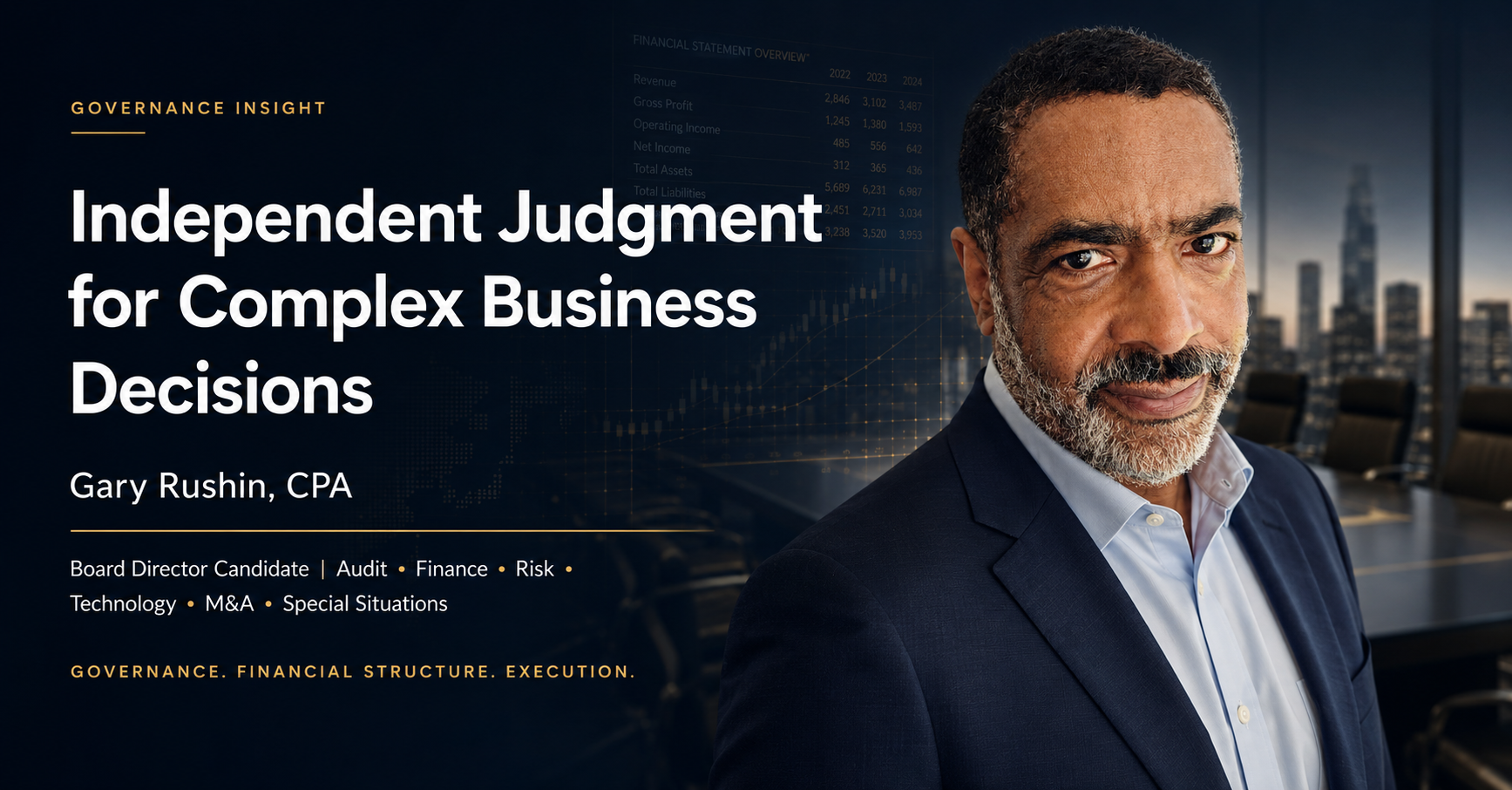
Gary Rushin brings an independent director’s perspective grounded in financial reporting, commercial and investment banking, corporate turnarounds, manufacturing, technology, transactions, international risk, and executive leadership.
He helps boards examine the distance between what management reports, what the numbers reveal, and what the business is actually experiencing.
Governance. Financial Structure. Execution.
Strong governance is not created by policies, presentations, and scheduled meetings alone.
It is created when directors understand the business well enough to challenge assumptions, test management’s conclusions, identify hidden exposures, and demand accountability without interfering with management’s responsibility to operate the company.
The most effective directors know when to support management, when to ask another question, and when the evidence no longer supports the narrative.
Gary brings that discipline to the boardroom.
His approach is practical, financially grounded, operationally informed, and independent of management optimism.
A board cannot govern effectively when financial reporting is late, incomplete, inconsistent, or disconnected from the company’s operations.
Revenue growth may conceal weak margins.
Reported profit may conceal deteriorating cash flow.
A healthy backlog may conceal execution risk.
An acquisition may create scale while destroying value.
A technology investment may improve capability while introducing new control failures.
Gary helps boards move beyond reported results and examine the underlying economic reality.
Growth is not automatically evidence of organizational strength.
Rapid expansion can expose weak accounting systems, inadequate controls, management limitations, working-capital pressure, technology gaps, and unclear decision rights.
A company can sink into a liquidity crisis just as easily as it can achieve market leadership.
Gary helps boards evaluate whether the company’s financial systems, people, controls, governance structure, and operating processes are keeping pace with its ambitions.
Liquidity problems rarely appear without warning.
They are usually preceded by signals:
Boards should not discover cash-flow problems after management runs out of options.
Gary brings a banker’s understanding of capital, a CFO’s understanding of cash, and a turnaround operator’s understanding of what happens when warning signs are ignored.
Boards approve strategies. Companies succeed or fail through execution.
The gap between the two is where value is often lost.
Gary helps directors examine whether strategic objectives are supported by:
A strategic plan without operating discipline is not a strategy. It is an aspiration.
Technology is no longer a separate operational concern delegated entirely to the chief information officer.
Cybersecurity, artificial intelligence, enterprise systems, automation, data integrity, privacy, business continuity, and digital transformation now affect financial reporting, customer confidence, regulatory exposure, competitive position, and enterprise value.
Gary’s background in accounting, information technology, systems implementation, automation, and executive management allows him to evaluate technology through a business and governance lens.
The board does not need to manage the technology.
It must understand the consequences when the technology fails.
Directors must be able to rely on management without becoming dependent on management’s interpretation of events.
Independent verification does not imply distrust.
It is a basic governance discipline.
Gary helps boards identify where additional evidence, reporting, testing, analysis, or outside expertise may be required before accepting a major conclusion.
That discipline becomes especially important during:
Gary’s value begins with the questions that help directors uncover what standard reporting may not reveal.
Do the reported results reflect the true economics of the business?
Are accounting policies producing transparency, or merely technical compliance?
What assumptions have the greatest effect on earnings, assets, liabilities, and cash flow?
Where is management judgment most likely to obscure risk?
How much cash does the company truly have available?
What could cause the forecast to fail?
How quickly can receivables, inventory, debt obligations, or operating losses create a liquidity problem?
Does the capital structure support the strategy?
Which operating problems are already appearing in the financial statements?
Where is growth placing pressure on people, processes, systems, and controls?
What critical activities depend on one individual, one customer, one vendor, or one technology platform?
What must be true for the strategy to succeed?
What evidence supports those assumptions?
What are the leading indicators that the strategy is working—or failing?
Has management defined the point at which the company should change course?
What value is the company actually acquiring?
Are projected synergies operationally achievable?
What integration risks are not reflected in the purchase model?
Who owns the post-closing results?
Does the board understand the company’s material technology dependencies?
Are cybersecurity and data risks presented in business terms?
Does the company have appropriate governance over artificial intelligence, automation, privacy, and third-party platforms?
Are technology investments producing measurable economic value?
Does management report problems early?
Are incentives aligned with long-term enterprise value?
Do the board’s metrics encourage sound decisions or short-term behavior?
Is the board receiving analysis, or simply receiving information?
Experienced directors often create value by recognizing patterns before those patterns become crises.
Gary has worked across banking, investment analysis, manufacturing, technology, accounting, international finance, restructuring, education, and executive management.
That range allows him to recognize connections that may be missed when a problem is viewed through only one functional lens.
He is particularly alert to:
These are not merely accounting issues.
They are early indicators of governance, leadership, operating, and enterprise-value risk.
Gary Rushin is a Wall Street-trained CPA, former commercial and investment banker, corporate turnaround professional, manufacturer, CFO, CEO, international financial adviser, and university professor.
His experience includes:
He began his banking career at Irving Trust Company at One Wall Street, where he analyzed complex corporate and international credit exposures.
He later served in commercial banking, corporate finance, investment banking, manufacturing leadership, information technology, and financial executive roles.
His international work has included advising the Bank of Ghana through a World Bank engagement and teaching accounting, finance, mergers and acquisitions, and financial analysis to executives and graduate students in the United States, China, and India.
This breadth allows Gary to evaluate a company through multiple lenses:
Director. CPA. Banker. Investor. CFO. Operator. Technologist. Educator.
Gary can help the audit committee examine:
His focus is not limited to whether the numbers comply with accounting standards.
He also asks whether the numbers fairly explain the condition of the business.
Gary contributes experience in:
He helps boards distinguish between companies that are profitable on paper and companies that are financially resilient.
Gary helps boards connect risk categories that are too often reviewed separately.
These include:
The objective is not to eliminate risk.
It is to ensure the company understands which risks it is taking, why it is taking them, and whether it can withstand the consequences.
Gary can help directors evaluate:
He translates technology issues into the language of governance, capital, controls, and enterprise value.
Gary’s banking, finance, operating, and turnaround background is relevant to:
Special situations require directors who can evaluate incomplete information without becoming paralyzed by uncertainty.
Gary’s value is not limited to a single committee or functional specialty.
He operates across the points where boards most often encounter incomplete information, competing incentives, and hidden risk:
He helps boards ask better questions before the numbers deteriorate, before liquidity tightens, before an acquisition loses momentum, and before a manageable weakness becomes a public problem.
A company selecting Gary Rushin as a director or board adviser gains:
A director who understands the accounting, but does not stop at the accounting.
A board member willing to test assumptions, examine contradictions, and pursue the underlying facts.
An executive who has managed companies, employees, systems, customers, lenders, and difficult decisions.
A former banker who understands how investors and lenders evaluate performance, risk, liquidity, and management credibility.
A director capable of examining deal logic, valuation, financing, integration, and post-closing accountability.
A financially trained executive who understands enterprise technology, automation, data, cybersecurity, and artificial intelligence as governance matters.
An operator who recognizes deterioration early and understands the discipline required when time, cash, and strategic options become limited.
A director who can challenge management without turning governance into obstruction.
Why sophisticated investors evaluate financial systems, governance, controls, and execution—not just the business idea.
Gary regularly writes and speaks on the issues that determine whether companies become durable, investable, and well governed.Investor-Grade InfrastructureWhy sophisticated investors evaluate financial systems, governance, controls, and execution—not just the business idea.
How investors, lenders, and acquirers identify weaknesses long before those weaknesses appear in the headline numbers.
Why profitable companies can still run out of cash—and why liquidity oversight belongs in the boardroom.
Why timely and accurate monthly reporting separates serious companies from organizations operating on assumptions.
Why founder heroics eventually become an operating risk—and what companies must build before they scale.
How directors can use the balance sheet, income statement, and cash-flow statement to understand what management presentations may leave unsaid.
Gary is particularly well suited for companies experiencing:
These are the moments when boards need more than prestige.
They need experienced judgment.
Gary is available to discuss:
Lorem ipsum dolor sit amet, consectetur adipiscing elit. Ut elit tellus, luctus nec ullamcorper mattis, pulvinar dapibus leo.
The right time to add financial, operating, technological, and turnaround judgment is before the company is forced to use it.
Gary Rushin, CPA
Board Director Candidate | Corporate Adviser | Former Banker, CFO, CEO and Turnaround Operator
Wall Street to Startup Street™